Overview


The client maintains National Grid transmission infrastructure, including overhead lines, towers and substations across remote, difficult terrain. Traditional “walk-the-line” inspections were slow, costly and sometimes unsafe, limiting inspection frequency and making it hard to capture consistent, complete corridor data.
They needed a safer, faster way to model line movement, assess vegetation clearance and growth risk, capture accurate terrain, tower & conductor geometry and support long-term maintenance and upgrade planning.
If left unchanged, the existing approach would continue to expose teams to safety risks, increase operational cost and limit the quality and completeness of the engineering data available for critical network planning.
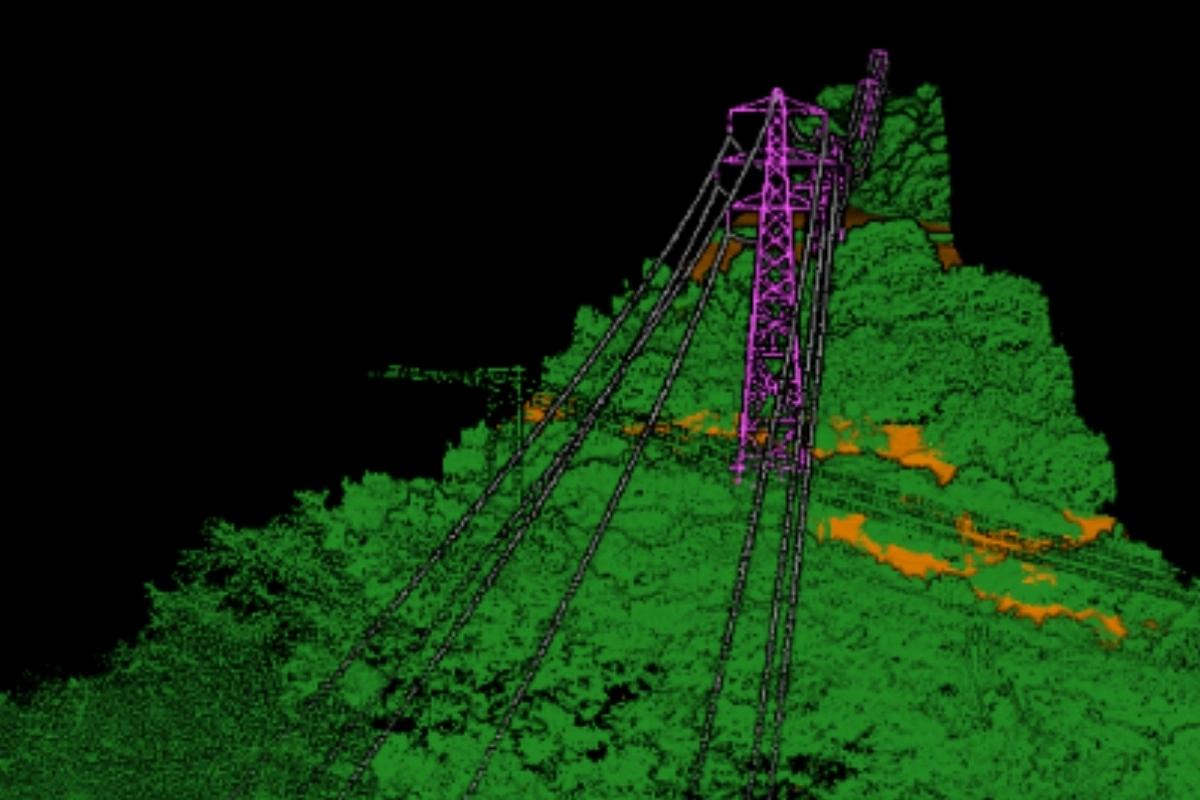
Vantage UAV delivered a full corridor LiDAR mapping survey across ~20km of live transmission infrastructure, capturing towers, conductors, substations and surrounding terrain to create a consistent, engineering-grade 3D dataset. Each section was flown with a 50m stand-off distance to reduce risk while maintaining extremely high data quality, with on-site verification using YellowScan CloudStation to ensure complete coverage before leaving each location.
The on-site quality control (QC) removed the risk of data gaps and avoided return visits. Post-processing using Applanix POSPac refined the trajectory and geo-referencing, before final classification and colourisation of the dataset.

Vantage UAV completed the survey across remote, difficult terrain and a long linear corridor, where access is often slow, complex and high-risk. The work was delivered safely around live transmission infrastructure and it was completed within a tight operational window without compromising data quality or corridor-wide consistency.
The resulting dataset supports a shift from visual inspection to full 3D, data-driven asset management. It is ready for automated vectorisation, tower, conductor and vegetation modelling and detailed clearance analysis with growth simulation to support proactive maintenance planning.